
The coverage focused on the resort. ADREC’s H1 2026 data, AED 117 billion in six months, has the better story.
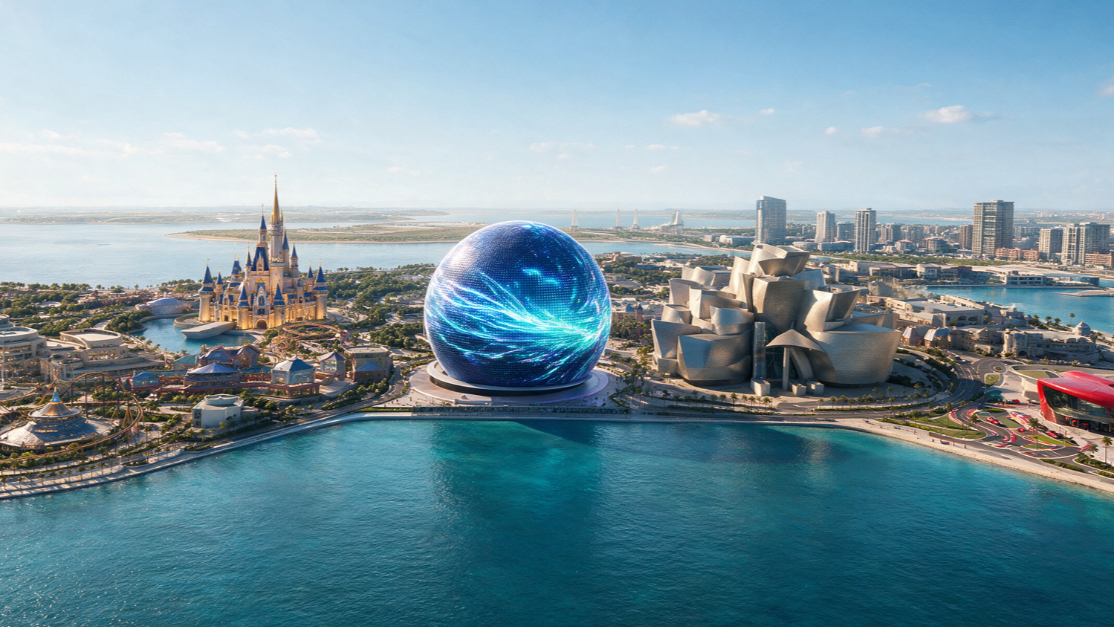
In May 2025, The Walt Disney Company and Miral confirmed that the first Disney theme park resort in the Middle East will rise on Yas Island. It will be Disney’s seventh resort destination worldwide, and the first built on this side of the planet in decades. Months earlier, Abu Dhabi had already secured another global first for the same island’s orbit: Sphere Abu Dhabi, the first international venue of its kind outside Las Vegas.
Two of the region’s biggest entertainment announcements, landing on the same island. The real subject, though, is not Yas. It is how Abu Dhabi turns destinations into districts.
A city that changed faster than its reputation
Abu Dhabi’s real estate market has spent four years quietly outgrowing every description of it. According to the Abu Dhabi Real Estate Centre (ADREC), total transaction values reached AED 142 billion in 2025, up 44 per cent from 2024. Residential sales alone climbed to AED 76 billion, roughly four times their 2022 level. The first quarter of 2026 then became the strongest on record, and the first half closed at AED 117 billion, up 112 per cent year on year. In six months, the emirate transacted more than 80 per cent of its entire 2025 total.
Beneath those totals sits a more structural shift. Demand has outpaced supply for four consecutive years: occupied homes grew 6.6 per cent annually between 2022 and 2025, more than double the 2.8 per cent growth in housing stock, and residential prices rose around 20 per cent between 2024 and 2025 as a result. Foreign buyers now account for the majority of residential sales value, and in the first half of 2026 foreign direct investment reached AED 13.8 billion, up 309 per cent and already exceeding the total recorded in all of 2025, with non-resident investors from 116 nationalities entering the market.
This is the market that Disney and the Sphere are entering. Not a promise waiting to be validated, but a demand curve already running ahead of the city’s ability to build.
The Yas pattern
Yas Island has run this experiment before. The island was master-planned around entertainment: the Formula 1 circuit arrived in 2009, the theme parks followed, and for a decade Yas was best understood as a place the world visited.
The residential story came after, and the data shows how decisively. ADREC’s 2025 annual report places Yas among the four districts that concentrated 85 per cent of the emirate’s off-plan apartment sales, a segment that grew 125 per cent in a single year. Together with Al Reem, the island now captures around 40 per cent of Abu Dhabi’s total residential sales volume. And on the demand side that matters most for a global destination, Yas accounts for 16 per cent of the emirate’s foreign direct investment sales value; combined with Saadiyat, the two islands hold 59 per cent of it.
In other words, the entertainment infrastructure did not remain a visitor economy. It became a residential one. People who came for the island’s attractions increasingly decided the island was worth living on, and buyers from abroad treated its addresses as a way into the emirate itself.
What the announcements change
Seen through that pattern, the Disney and Sphere announcements are not additions to a theme park district. They are the largest expansion of the very engine that turned Yas into a residential market.
Three things follow for the city, all of them visible in the data rather than speculative.
First, the visitor base widens. A Disney resort draws a demographic that the region’s existing attractions only partially reach: multi-generational family tourism at global scale. The Sphere does the same for live entertainment. Every previous expansion of Yas’s visitor economy has deepened the pool of people exposed to the island as a place, and some fraction of exposure has consistently converted into residency and ownership.
Second, the supply response is already planned. ADREC’s registered pipeline projects 11,137 additional residential units on Yas Island by 2030, one of the largest allocations in the emirate. Supply in the Abu Dhabi region is set to grow 3.3 per cent in 2026. The city is not building homes in response to the headlines. Those homes were already in the registered pipeline.
Third, the model compounds. Abu Dhabi has spent two decades assigning each island a role: culture on Saadiyat, finance on Al Maryah, entertainment on Yas. The strategy’s quiet strength is that each role generates its own residential demand, in its own segment, on its own timeline. The Disney and Sphere announcements are the strongest confirmation yet that the emirate intends to keep investing in the roles themselves, not only in the homes around them.
“As Abu Dhabi’s real estate sector evolves, what matters is not only how much it grows, but how it grows,” said Rashed Al Omaira, Director General of ADREC, presenting the first-half results for 2026. The discipline he describes is easiest to see on Yas: an island where the entertainment came first, deliberately, and the city has been building around what it set in motion ever since.
None of this guarantees anything about any single project, price or year, and this article makes no such claim. What the record does show is a consistent sequence: Abu Dhabi builds destinations, destinations build audiences, and audiences, given enough reasons to stay, become residents.
Few islands anywhere have seen two projects of this scale announced at once.
Sources: Abu Dhabi Real Estate Centre (ADREC), 2025 Abu Dhabi Real Estate Report and H1 2026 market results (via Abu Dhabi Media Office); The Walt Disney Company and Miral joint announcement, May 2025; Sphere Entertainment and the Department of Culture and Tourism Abu Dhabi announcement. Figures as published by their sources and subject to change. This article is market commentary, not investment advice.

Join The Discussion